

Course
Sivananda
traditional
basic structure
The traditional Sivananda course is fully in line with the tradition of Hatha Yoga, of which it constitutes a specific approach with its own structure and method of transmission.
This method was transmitted by Swami Vishnudevananda, a disciple of Swami Sivananda, and continues to be taught today in accordance with a tradition passed down for decades. This continuity preserves the spirit, coherence, and depth of the teaching, extending beyond mere physical practice.
In its intermediate form, the class follows a precise structure: initial relaxation, opening mantras, then the two fundamental pranayamas, Kapalabhati and Anuloma Viloma. The practice continues with Surya Namaskar, the Sun Salutation, before moving on to the 12 fundamental postures in their traditional order. The class concludes with a final relaxation and closing mantras, in order to fully integrate the effects of the practice.
This structure forms the traditional framework, but it remains dynamic and adaptable. Beginner classes offer a progression tailored to each individual's level, with preparations and modifications of the postures. In more advanced practices, variations and additional postures can be integrated, while maintaining the structure, spirit, and coherence of the traditional class.
The Sivananda method is thus distinguished by a structured, progressive and balanced Hatha Yoga, where breath, relaxation and asanas are integrated into a global approach to Yoga, faithful to the transmission of its teachers.
Initial relaxation
In the Sivananda tradition, each session begins with a period of relaxation in Savasana. Lying on the back, the body gradually relaxes while attention turns to the breath and sensations.
This first step allows you to step away from external distractions, release tension, and prepare your body and mind for the practice. It marks the transition to a calmer, more present, and receptive state before fully entering the session.


Opening Mantras*
(Dhyana Slokas)
In the Sivananda tradition, practice traditionally begins with the Gajānanam, a mantra intended to create a favorable and protective inner environment before starting.
Beyond any religious dimension, it can be understood as a way to set an intention, refocus the mind, and make oneself fully available for the practice. It symbolically invokes various qualities such as protection, wisdom, inner strength, and the ability to overcome obstacles.
Singing thus marks the passage between daily life and the space of practice, in a spirit of presence and contemplation.
Pranayama
Pranayama is the art of regulating and controlling the breath in order to influence prana, the vital energy. It plays a crucial role in the practice, particularly through Kapalabhati and Anuloma Viloma.
Practiced at the beginning of class, after the initial relaxation and mantras, it helps to clarify the mind, balance energy, and deepen breath awareness. It thus prepares the practitioner for Surya Namaskar and then for the asanas, creating the physical, energetic, and mental conditions conducive to a more mindful practice.

Khapalabhati
"the purifying breath"
Kapalabhati is a breathing purification technique (kriya) practiced in the Sivananda tradition. It consists of a series of short, dynamic exhalations through the nose, produced by abdominal contraction, while inhalation occurs naturally.
This practice helps cleanse the respiratory system, strengthen abdominal muscles, and stimulate breathing. Energetically, it promotes the flow of prana, brings vitality and mental clarity, and prepares the body and mind for subsequent practices.

Anuloma Viloma
"alternate nostril breathing"
Anuloma Viloma is an essential alternate nostril breathing practice in the Sivananda tradition. It consists of breathing alternately through each nostril, according to a precise and regular rhythm.
This practice helps to calm the nervous system, improve concentration, and soothe the mind. On an energetic level, it helps to balance the flow of prana in Ida and Pingala, the two main energy channels, thus promoting a state of equilibrium and preparing one for meditation.
Surya Namaskar
Surya Namaskar, the Sun Salutation, is a dynamic sequence of 12 poses synchronized with the breath. Alternating extensions, flexions, and stretches, it progressively mobilizes the entire body in a fluid and rhythmic movement.
In the structure of the traditional Sivananda class, it takes place after pranayama and before asana. It warms up the body, mobilizes the joints, loosens the spine and activates circulation, while deepening the coordination between movement and breath.
It thus constitutes a true transition between breathing work and postural practice, preparing both the body and the mind for the 12 fundamental asanas that follow.

Asanas
Asanas are the physical postures of Hatha Yoga. The practice is organized around a sequence of 12 fundamental postures, chosen to mobilize the body in a global and balanced way: flexions, extensions, inversions, twists and stretches.
One of the distinctive features of the Sivananda approach lies in the alternation between postures and regular periods of relaxation in Savasana, particularly after certain postures or groups of postures. These pauses are not superfluous: they allow for the release of tension, the regulation of breathing, the integration of the effects of the posture, and the observation of sensations before continuing.
This alternation between effort and relaxation gives the Sivananda class its particular rhythm and distinguishes it from many other approaches to Hatha Yoga.

1. Sirsasana
"the headstand"
Sirsasana, the headstand, is traditionally considered the "queen of asanas". This inverted pose engages the entire body while requiring stability, concentration, and breath control.
It helps strengthen the shoulders, arms, and abdominal muscles, while also promoting venous return. Mentally, it develops concentration, balance, confidence, and inner calm. Inversion also offers a shift in perspective that encourages slowing down and fully focusing on the present moment.

2. Sarvangasana
"the posture on the shoulders"
Sarvangasana, the shoulder stand, is a major inverted posture in the Sivananda tradition, traditionally called the "queen of asanas".
It promotes venous return, stretches the cervical region, and strengthens the body's stability. The position also exerts gentle compression on the throat. Mentally, Sarvangasana invites calmness, introspection, and concentration, fostering a state of deep relaxation and balance.

3. Halasana
"the plow stance"
Halasana, the plow pose, is a natural extension of Sarvangasana. The body folds backward, with the legs passing over the head, creating a deep stretch of the entire posterior chain.
It helps to loosen the spine, stretch the back and shoulders, and promote physical relaxation. On a mental level, this posture encourages introspection, calmness, and letting go, naturally preparing the body for the relaxation that follows.

4. Matsyasana
"the fish pose"
Matsyasana, the fish pose, is traditionally practiced after Sarvangasana and Halasana as a counter-pose, opening the chest and throat area wide.
It helps to stretch the rib cage, open the shoulders, and promote deeper breathing, while also mobilizing the upper spine. On a mental level, this opening fosters a sense of spaciousness, vitality, and relaxation, following the internalization of the preceding postures.

5. Paschimottanasana
"the seated clamp"
Paschimottanasana, the seated forward bend, is a forward bend that provides a deep stretch to the entire posterior part of the body, from the legs to the spine.
It helps to loosen the back and legs, mobilize the spine, and gently massage the abdominal area. On a mental level, bending forward naturally promotes introspection, calmness, and letting go, inviting you to turn your attention inward and toward your breath.

6. Bhujangasana
"the cobra pose"
Bhujangasana, the cobra pose, is a back extension that opens the chest and mobilizes the spine, while also engaging the back muscles.
It helps strengthen the back, improve spinal mobility, and open the rib cage, thus promoting deeper breathing. On a mental and energetic level, this posture cultivates a sense of openness, vitality, and confidence, while also stimulating the flow of prana.

7. Salabhasana
"the grasshopper posture"
Salabhasana, the locust pose, is a back extension performed on the stomach that particularly engages the lower back, buttocks and the back of the legs.
It helps strengthen the posterior chain, support spinal stability, and tone the abdominal region. On a mental and energetic level, it develops willpower, concentration, and perseverance, while providing a feeling of strength and vitality.

8. Dhanurasana
"the bow posture"
Dhanurasana, the bow pose, is a dynamic back extension in which the body takes the shape of a bow, combining chest opening, spinal extension, and stretching of the front of the body.
It helps strengthen the back, increase spinal flexibility, and open the shoulders and rib cage, while also stimulating the abdominal area. On a mental and energetic level, it promotes vitality, confidence, and dynamism, while developing concentration and determination.

9. Ardha Matsyendrasana
"the spinal half twist"
Ardha Matsyendrasana, the half spinal twist, is a posture that mobilizes the spine in rotation while maintaining stability, lengthening of the back and opening of the chest.
It helps to loosen the spine, stretch the back muscles, and gently massage the abdominal area. On a mental and energetic level, it promotes concentration, balance, and centering, while stimulating the flow of prana.

10. Kakasana
"the crow's posture"
Kakasana, the crow pose, is a handstand that requires strength, stability and concentration, while gradually developing confidence in one's support.
It helps strengthen the wrists, arms, shoulders, and abdominal muscles, while improving balance and coordination. On a mental level, it particularly develops concentration, self-confidence, and the ability to manage anxiety, encouraging one to remain fully present.

11. Pada Hasthasana
"the standing clamp"
Padahastasana, the standing forward bend, is a forward bend that provides a deep stretch of the entire posterior chain, from the legs to the back.
It helps to loosen the legs and spine, stretch the back muscles, and promote overall body mobility. On a mental level, it encourages introspection, calmness, and letting go, while developing presence and concentration.
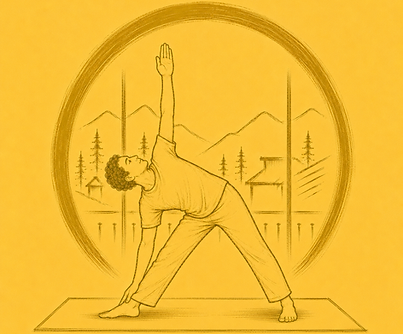
12. Trikonasana
"the triangle posture"
Trikonasana, the triangle pose, is a standing pose that combines lateral stretching, opening and stability, while harmoniously engaging the whole body.
It helps to loosen the spine, strengthen the legs, open the hips and rib cage, while improving balance and coordination. On a mental and energetic level, it promotes grounding, concentration, and a sense of balance, providing a dynamic and harmonious conclusion to the series of twelve postures.
Final relaxation
In the Sivananda tradition, each session ends with deep relaxation in Savasana. After the various practices, the body becomes completely still in order to gradually release tension and allow breathing to return to its natural rhythm.
This final relaxation is an essential part of the class: it allows the body and nervous system to integrate the effects of the practice, while promoting deep physical and mental calm. It is a time for integration, silence, and returning to oneself before resuming activities.
Closing Mantra **
(Mahā Mṛtyuñjaya Mantra)
The Mahā Mrtyuñjaya Mantra, also called Om Tryambakam, is traditionally chanted at the end of practice in the Sivananda tradition. It is considered a mantra of protection, healing, and peace.
Beyond any religious dimension, it can be experienced as a way to close the session with a benevolent intention, wishing health, strength, and peace for oneself and others. It thus allows one to end the practice in a state of calm, openness, and unity before returning to daily life.
Appendices
Words of the mantras
*Dhyana Slokas
(Gajananam)
Gajānanam bhūta ganādi sevitam
Kapittha jambū phala sāra bhaksitam
Umā sutam śoka vināśa kāranam
Namāmi vighneśvara pāda pankajam
Sadānanam kunkuma rakta varnam
Mahāmatim divya mayūra vāhanam
Rudrasya sūnum surasainya nātham
Guham sadā’ham śaranam prapadye
Yā kundendu tusāra hāra dhavalā
Yā śubhra vastrā vrtā
Yā vīnā vara danda mandita karā
Yā śveta padmāsanā
Yā brahmācyuta śankarah prabhrtibhir
Devais sadā pūjitā
Sā mām pātu sarasvatī bhagavatī
Niśśesa jādyāpahā
Om namaśśivāya gurave saccidānanda mūrtaye
Nisprapañcāya śāntāya Śrī Śivānandāya te namah
Śrī Visnudevānandāya te namah
Om sarva mangala māngalye Śive sarvārtha sādhike
Śaranye tryambake Gauri Nārāyani namo’stu te
Nārāyani namo’stu te
Om saha nāvavatu saha nau bhunaktu
Saha vīryam karavāvahai tejasvi nāvadhītamastu
Mā vidvisāvahai
Om śāntiś śāntiś śāntih
**Mahā Mṛtyuñjaya Mantra
(Om Tryambakam)
Om tryambakam yajāmahe
Sugandhim pusti vardhanam
Urvārukamiva bandhanān
Mrtyor muksīya mā'mrtāt
Om sarvesām svastir bhavatu
Sarvesām śāntir bhavatu
Sarvesām pūrnam bhavatu
Sarvesām mangalam bhavatu
Sarve bhavantu sukhinah
Sarve santu nirāmayāh
Sarve bhadrāni paśyantu
Mākaś cid duhkhabhāg bhavet
Asato mā sad gamaya
Tamaso mā jyotir gamaya
Mrtyor mā amrtam gamaya
Om pūrnamadah pūrnamidam
Pūrnāt pūrnamudacyate
Pūrnasya pūrnamādāya
Pūrnamevāvaśisyate
Om śāntiś śāntiś śāntih